Solutions · For Resilience and Risk Advisors
Change Risk & Cloud Resilience Baseline
Know what a change will break, and how you would recover.
Most outages start with a change, and recovery depends on knowing what depends on what. The baseline gives resilience and risk advisors a live dependency map of every critical service: the blast radius of a change before it ships, and the inputs to judge recovery when something goes wrong. Then your client's team and their AI agents can check any change against the same map, before it ships.
Read-only. Nothing changes in your client's environment.
The Gap
Operational risk lives in the dependencies.
Resilience reviews still start from interviews, runbooks and spreadsheets. Meanwhile the estate changes every day, and more of those changes now come from AI. This month a disaster-recovery test at Workday reached live databases and locked employees out of HR and payroll.
- Most outages start with a change A config edit, an update or a test that reached further than anyone expected.
- Recovery plans assume a map nobody has Recovery order, failover and recovery targets depend on dependencies that live in people's heads.
- Every tool sees its own slice Backup, monitoring and security tools report what they manage, not what depends on it.
- AI agents now make changes too They act fast, and without the map they cannot see what a change will reach.
How the Map Lowers Risk
One dependency map. Three moments that matter.
The map is the Cloud Intelligence Graph™: a live picture of what runs, what depends on what, and who owns it, built from the live estate under read-only access. Advisors use it to assess, and the client's team keeps using it every day. How the graph works →
- Before a change
- See the blast radius first What a change touches, which critical services depend on it, what cannot be undone, and who owns it.
- When something goes wrong
- Judge recovery from real dependencies Advisors assess recovery order, failover, single points and backup coverage against what is actually running.
- Every day after
- Arm the team and their AI agents Engineers and their AI tools can check the blast radius of any change before it ships, on the same shared map in OpsCanvas Pro.
- Remediate findings safely → Findings from backup vendors, security tools or the assessment are checked against the map, given an owner and fixed with a person approving.
- Control what agents can do Agent action controls in OpsCanvas Enterprise: coming 2027, design partners now.
What the Baseline Delivers
A two to three week baseline of change and recovery risk.
Every finding comes from the live graph and is labeled with where it came from: read live, derived from the graph, or confirmed by the client's team.
- A dependency map of every critical service What each one runs on, the shared single points underneath them, and who owns each part.
- A change risk register The resources where a change does the most damage, with drift from code, write access for people and AI tools, and the first fix for each.
- Recovery inputs for the advisor Recovery order from real dependencies, failover by region and provider, and backup coverage against the whole estate.
- A posture score and a 30, 60, 90 day plan The exposures to fix first, and the map the team keeps checking changes against afterward.
- Owned tasks that keep running on Pro Every finding becomes a task with an owner, kept current as the estate changes.
See a Sample Report
What the client gets back.
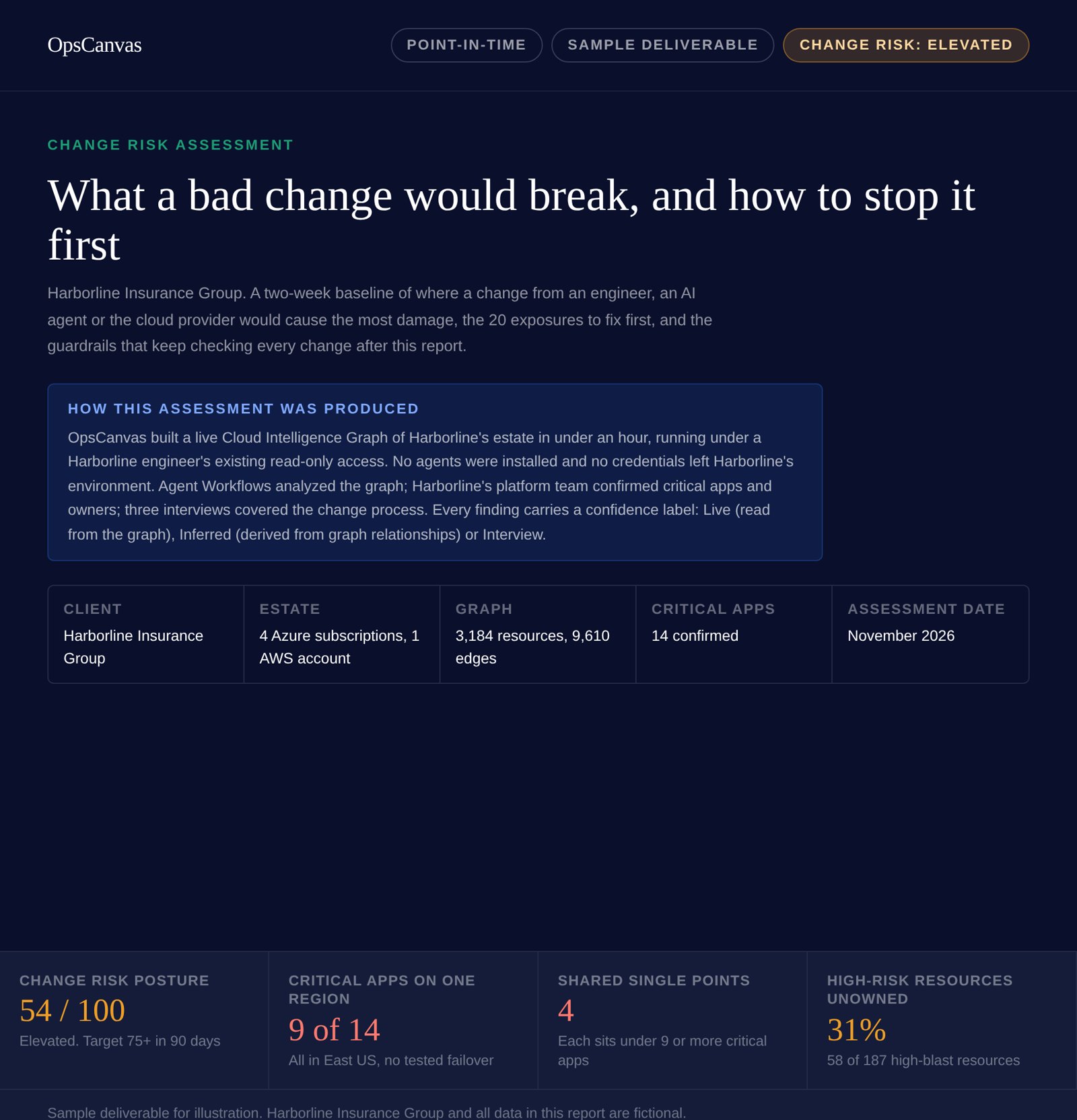
A sample change risk report for Harborline Insurance Group, an invented company: 3,184 resources mapped, a posture score of 54 out of 100, 9 of 14 critical apps in one region with no tested failover, and a plan to reach 75. Download the sample report (PDF) →
The Readout
Score, scope and the four numbers that matter.
Critical apps on one region, shared single points, and high-risk resources nobody owns.
The Evidence
The critical path, and what fails with the provider.
Claims intake mapped from the graph, and every shared provider dependency with the apps that fail with it.
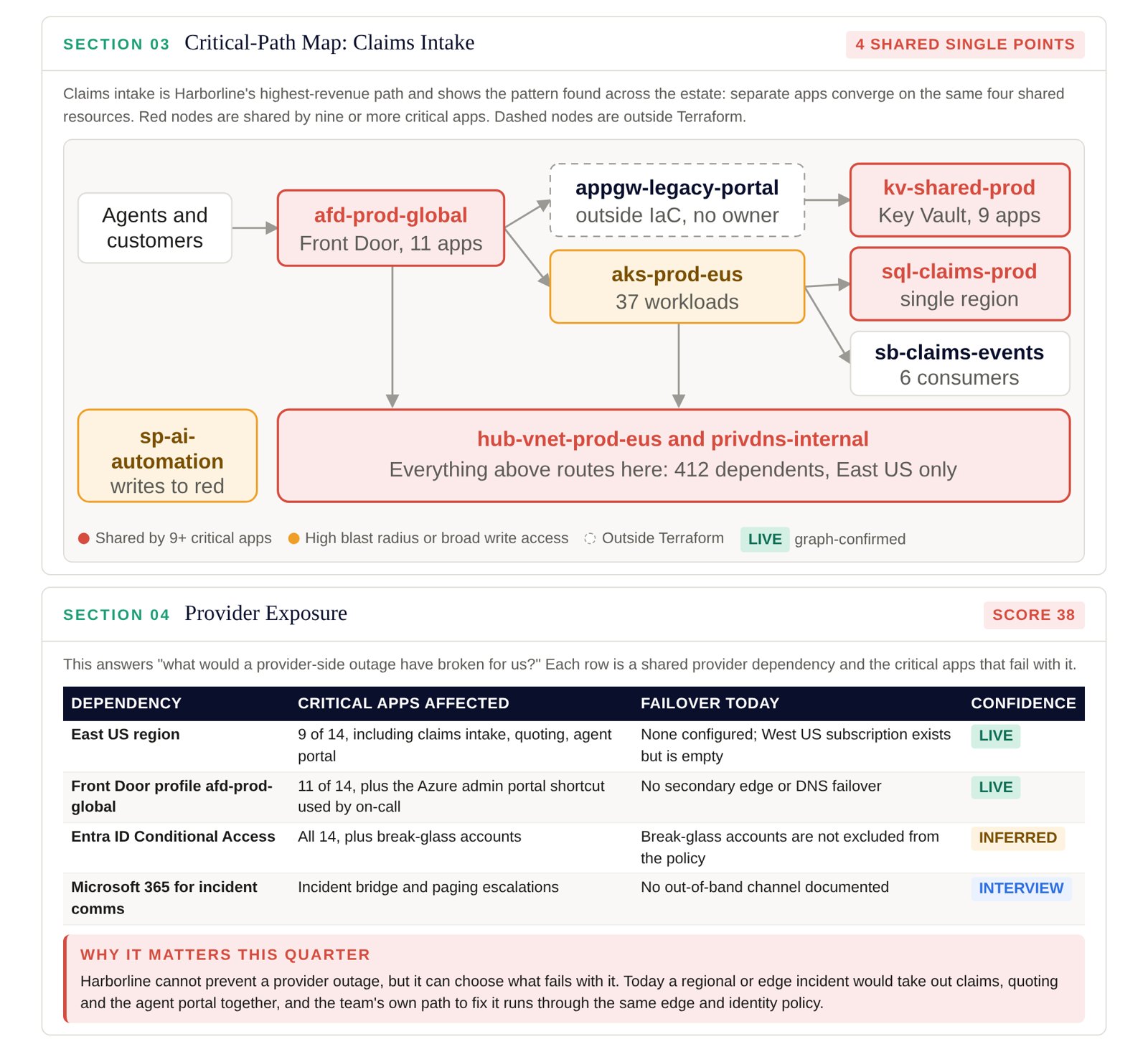
Sample deliverable. Harborline Insurance Group and all data in the report are fictional.
For Resilience and Risk Advisors
Deliver the baseline. Keep the client protected.
For resilience, risk and continuity consultancies, and the service providers who run their clients' clouds. OpsCanvas is a neutral evidence layer: it works alongside any backup, monitoring or security tool the client already has.
- The dependency map in days Replace weeks of interviews and spreadsheets with a live map your team reviews and confirms.
- Recovery assessments grounded in what runs Judge recovery capability, single points and failover from live dependencies, not documentation.
- A recurring service, not a one-time report Ongoing change protection on Pro keeps you in the account between assessments and incidents.
- Findings closed, not just reported Gaps from the assessment or the client's backup vendor become owned tasks, remediated safely against the map.
- A path to agent controls As clients give AI agents more autonomy, agent action controls in Enterprise build on the same map. Coming 2027, design partners now.
- Delivered under your brand Run the baseline as your own service, with OpsCanvas behind it.
Partner with us Talk to us about delivering the baseline
The Difference
A resilience review, with and without a live map.
OpsCanvas does not back up or restore data, scan for malware, or enforce policy on its own. It is the source of truth for what depends on what. Your backup and security tools keep their jobs, and changes stay with your team and its AI tools, under your approval.
FAQ
Change and Resilience Baseline, answered.
Who is the baseline for?
Resilience, risk and continuity advisors and the service providers who deliver to their clients, and the platform and risk leaders who hire them. It can also be run directly with OpsCanvas.
How long does it take, and what does the client provide?
Two to three weeks. The graph builds in minutes under an engineer's existing read-only access, and the client's team spends a few hours confirming critical services and owners.
Does it replace backup, monitoring or security tools?
No. It maps what depends on what, so those tools' findings can be judged and fixed safely. Their platforms keep protecting, watching and restoring.
Will anything change in the client's environment?
No. Building the graph uses only read-only actions, and nothing changes without a person approving it. Fixes are proposed as tasks for the client's owners.
Does it help with operational resilience rules like DORA?
It gives a live, evidence-backed map of the dependencies behind critical services, a core input to dependency mapping and resilience testing. It is not a compliance certification.
Change and Resilience Baseline
Know what could break. Before it does.
Talk to us about delivering the baseline to your clients, or book a call to scope one for your own estate.