Solutions · From Findings to Fixed
You don't need more findings. You need them fixed.
One queue. Ranked by real ROI. Finished with AI assistance.
Your tools already found the problems. The hard part is knowing where to start and carrying each improvement through to done. OpsCanvas turns findings from every source into one prioritized queue of safe, owned, tracked improvements, and Oscar helps your team complete them.
Human approval on every action. Nothing changes without you.
The Problem
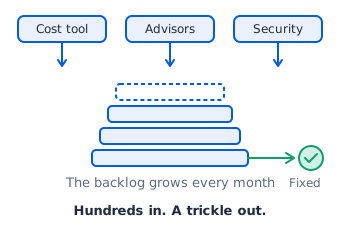
Findings keep stacking up. Fixes don't.
A mid-size cloud estate generates hundreds to thousands of findings a month across cost, resilience, security, and AI tools. Detection is mostly solved. Completion is not.
- They never stop: every scanner, advisor, and platform adds to the pile daily, on top of last month's unactioned findings
- They arrive flat and unowned: severity scored through each tool's own lens, with no business impact, dependencies, or owner. An unprotected dev VM and a revenue-critical database can carry the same severity
- The last mile is where value dies: tools remediate only their own objects; the rest exits as context-free tickets or sits in a dashboard until someone suppresses it
- In the FinOps Foundation's State of FinOps survey, practitioners rank getting engineers to act on recommendations as their top challenge
The System of Improvement
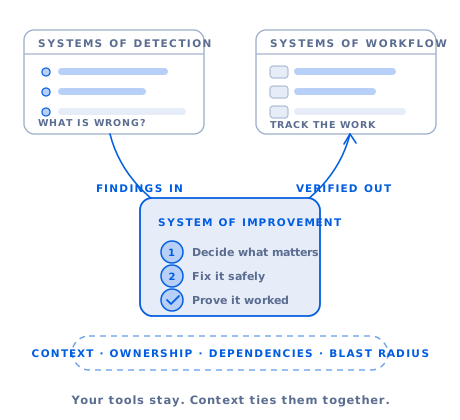
Detection tools answer the question 'what is wrong?'. Workflow systems track work someone already decided to do. OpsCanvas is the System of Improvement: the layer between them that decides which findings matter, turns them into safe, owned, prioritized improvements, helps your team complete them, and proves the outcome. Context is the unlock: the Cloud Intelligence Graph™ supplies the ownership, dependencies, and blast radius that make prioritization defensible and AI-assisted remediation safe. Findings are the input. Verified improvements are the value.
Findings Sources
Wherever your findings come from, they get the same treatment.
Oscar correlates every finding against the Cloud Intelligence Graph™, whether Oscar produced it, an assessment produced it, or a tool you already own produced it.
- Oscar built-insdaily findings from skills every operator has from the first session, like Health Check and Cost Summary
- OpsCanvas Assessmentsstructured findings for the parts of your cloud where you have none, or want a second opinion: backup posture, cost, AI readiness
- Cloudability (supported)rightsizing, idle, and anomaly findings imported and made safe to act on with Oscar Pro for Cloudability
- Cloud Provider ToolsAWS Trusted Advisor, Cost Explorer, and Compute Optimizer, plus Azure Advisor, rolling out
- More 3rd Party SourcesRubrik, Veeam, Commvault, Wiz, Datadog, and ServiceNow, as both a source and a ticket target
Correlation
Many findings. One improvement.
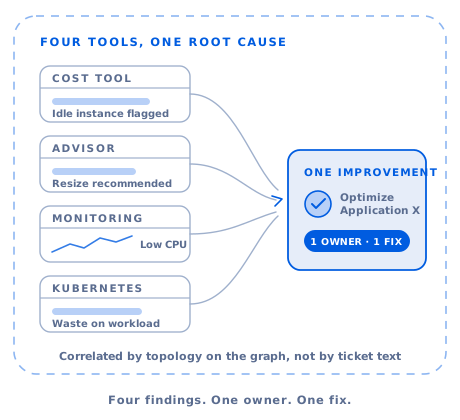
Your cost tool flags an idle instance. Your cloud advisor recommends a resize. Your monitoring shows low CPU. Your Kubernetes tool flags waste on the same workload. Four tools, four tickets, four owners guessing at the same root cause.
Because every finding lands on the same graph, Oscar sees they are one improvement: optimize the application they all belong to. One owner, one change, four findings closed.
- Cross-tool correlation by topology, not by ticket text
- One fix closes many findings, and the queue records which ones
- Symptoms stop being remediated fifteen times, or not at all
How It Works
The improvement engine.
Six moves, every one on the record.
This is the loop that turns a findings backlog into finished work. Safety verdicts are never silent: every position carries safe, unsafe, or needs review with explicit reasoning, and ownership is inferred from graph evidence with no tagging prerequisite.
Why It's Safe
The Cloud Intelligence Graph™ is why this is safe and fast.
An AI agent is only as honest as its context. Recommendations stall because no API carries dependencies, ownership, change history, or blast radius. The graph carries all four, so prioritization is defensible and remediation is safe instead of hopeful.
Cloud Intelligence Graph™Live · Multi-cloud · No tagging required
Findings
Prioritization
Tasks
Institutional memory, not tribal knowledge.
Every investigation, decision, and completed fix accrues in the graph as durable organizational knowledge. The context that made this quarter's remediations safe makes next quarter's faster. Oscar gets more capable with every improvement your team completes.
- ✓Decisions carry evidence and reasoning you can audit later
- ✓Ownership and dependency answers improve with every fix
- ✓Knowledge stays with the organization, not the person who left
The Difference
A findings backlog, with and without an improvement engine.
What matters
TODAY'S BACKLOG
WITH OPSCANVAS
Where findings live
TODAY'S BACKLOGPer tool, per team, per dashboard
WITH OPSCANVASOne queue across every source
The fix
TODAY'S BACKLOGManual work from a context-free ticket
WITH OPSCANVASAI-assisted remediation, human approval on every action
Priority
TODAY'S BACKLOGEach tool's severity, no common scale
WITH OPSCANVASROI-ranked with safety verdicts and reasoning
Ownership
TODAY'S BACKLOGHuman triage; tickets bounce for days
WITH OPSCANVASInferred from graph evidence, right owner first pass
After the fix
TODAY'S BACKLOGTicket closed, outcome unknown
WITH OPSCANVASVerified against the environment and billing data
Next month
TODAY'S BACKLOGThe pile grows back
WITH OPSCANVASNew findings enter the same queue; drift in assessed areas re-queues automatically
Complementary By Design
Your detection tools and ticketing system stay. We add context.
OpsCanvas does not compete with the tools that find problems or the systems that track work. What neither side has is context: the ownership, dependencies, and blast radius that turn a finding into a safe, prioritized fix. That is the layer we add, and it makes both sides more valuable. When you need discovery help, Oscar and OpsCanvas Assessments produce findings too: for the areas where you have no coverage, or want a second opinion on your position.
Workflow systems like ServiceNow and Jira are integration targets: we import findings from them, create tickets in them, update status as work completes, and report verified outcomes back.
- Systems of Detection answer: what is wrong?
- Systems of Workflow track: what did we agree to do?
- The System of Improvement decides what matters, finishes it safely, and proves it
Oscar In Your Tools
Questions your AI assistant or LLM can't answer on its own.
Connecting an agent to your cloud gives it your data. It does not give it understanding. Without the graph there are no dependencies, no owners, no change context, and no memory of what was already tried. With it, these become answerable:
1
Which of these rightsizing recommendations can I execute safely this week?
2
What breaks if this resource goes away?
3
Who owns this, and who needs to approve the change?
4
Which of these thousand findings are the same problem?
5
What did we fix last quarter, and did it stay fixed?
Now Available
OpsCanvas is now in Claude Code, Claude Desktop, OpenAI Codex, and ChatGPT Desktop. The same graph, inside the tools your team already works in.
Install OpsCanvas MCP where your team already works and every answer comes back grounded in your live estate, with the dependencies attached. Free with an OpsCanvas account. Oscar Pro adds the shared graph and a team task queue. One graph. Your whole team.
FAQ
From Findings to Fixed, answered.
What is a System of Improvement?
A System of Improvement sits between detection tools and workflow systems. Detection tools answer 'what is wrong?'. Workflow systems track work someone already decided to do. The System of Improvement decides which findings matter, turns them into safe, owned, prioritized improvements, helps your team complete them with AI assistance, and verifies the outcome against the live environment.
Does OpsCanvas replace ServiceNow, Jira, or my detection tools?
No. Detection tools are findings sources, and OpsCanvas makes their output more valuable by turning it into completed, verified improvements. ServiceNow and Jira are integration targets: OpsCanvas imports findings, creates tickets, updates status, and reports verified outcomes back into them.
Where do the findings come from?
Three places. Oscar's built-in skills like Health Check and Cost Summary produce daily findings. OpsCanvas Assessments produce structured findings for areas where you want deeper answers, like backup posture or cost. And imports bring in findings from tools you already own, starting with Cloudability, with more sources rolling out.
How does OpsCanvas decide what is safe to act on?
Every finding is correlated against the Cloud Intelligence Graph™, which holds topology, dependencies, ownership, change history, and blast radius observed from your environment. Each queue position carries a safety verdict of safe, unsafe, or needs review, with explicit reasoning, and a human approves every action before anything changes.
How do you measure improvement?
Two ways. Completion: the change is verified against the live environment, with time to remediate on the record. Impact: for cost findings, savings are confirmed against billing data over time. Closing a ticket is not verification, and resolved problems are watched so quiet returns show up as new findings.
Get Started
Bring us the findings you already have.
Start with your Cloudability backlog, run an assessment where you need answers, or put Oscar to work on your daily operations.