Solutions · Daily Cloud Operations
What could you accomplish with Oscar today?
Not just a project. Not just a prompt. Your working day, with context.
If you run cloud for a living, most tools want to sell you a transformation. This page is about Tuesday. The health check before standup, the cost question from finance, the incident at 2pm, the change you'd rather not break production with. Oscar covers the daily work, grounded in a live graph of your environment.
Free download. Runs locally. Your credentials never leave your machine.
Oscar is an AI cloud engineering agent grounded in the Cloud Intelligence Graph™, a live picture of your resources, dependencies, ownership, cost, and change history. That grounding is the difference between an assistant that talks about clouds and one that knows yours. Here is what that means across a normal day.
A Day With Oscar
The daily work, one prompt at a time.
Every answer below draws on the graph: topology, ownership, dependencies, change history. No tagging project first, no dashboard archaeology.
Illustrative answers from a sample environment.
The Checklist
The daily operations capabilities checklist.
Print this against your current tooling. Each line is something a cloud engineer does regularly, and something Oscar does with the graph behind it.
- Health check: every account each morning, with findings queued and owners suggested
- Cost summary: on demand, with the why behind every change in spend
- Incident investigation: correlated across deploys, config, and dependencies
- Pre-change safety: dependencies, blast radius, and who to notify
- Ownership: answers from evidence, not stale wiki pages or tag hygiene
- Backup readiness: checked against actual recovery points
- The queue: one prioritized improvement queue absorbing findings from every source
- AI-assisted fixes: human approval on every action, verification after
When The Day Gets Bigger
The same graph can handle big jobs, too.
Daily operations and major initiatives run on the same understanding. When a day's finding becomes a quarter's project, nothing starts over.
Reduce Cloud CostsAssessment available
Where are we overspending, and what is safe to reclaim?
Improve Backup ReadinessAssessment available
Can we actually recover, and can we prove it?
Investigate an IncidentJourney page coming
What happened, what did it touch, and how do we keep it closed?
Initial Project DiscoveryAssessment available
Where do we start, and what is actually connected to what?
Evaluate AI ImpactAssessment available
What is AI costing us, what are our agents doing, and what could go wrong?
Compounding
Each day worked in Oscar makes the next one faster.
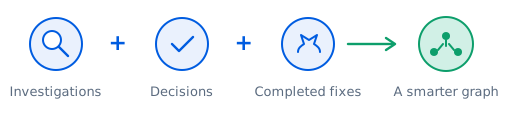
Every investigation, decision, and completed fix accrues in the Cloud Intelligence Graph™ as institutional memory. The dependency you mapped during an incident is already there for next month's change review. The ownership question you settled once stays settled.
That is the quiet difference between an AI chat session and a system: the session forgets, the graph remembers, and Oscar gets more capable with every improvement your team completes.
OpsCanvas is now in Claude Code, Claude Desktop, OpenAI Codex, and ChatGPT Desktop. The same graph, inside the tools you already work in.
Install OpsCanvas MCP where you already work and ask your cloud anything in plain English: what needs attention this morning, what changed overnight, and what breaks if you touch it. Free with an OpsCanvas account. Oscar Pro adds the shared graph and a team task queue, so context stops living in one person's session.
FAQ
Daily Cloud Operations, answered.
Who is Daily Cloud Operations for?
DevOps engineers, SREs, platform engineers, and cloud engineers who want an AI agent that helps with the regular work: health checks, cost questions, incident investigation, safe changes, and working a prioritized improvement queue. No transformation program required.
How is this different from the Oscar product page?
The Oscar Ops page describes the product: how Oscar works, what it connects to, and how it stays safe. This page describes the work: what a normal operating day looks like with Oscar in it. Same agent, same graph.
Do I need to tag or configure my environment first?
No. Oscar builds the Cloud Intelligence Graph™ from how your environment actually behaves: runtime signals, IaC repositories, and identity systems. Ownership and dependencies are inferred from evidence, and tag fixes come out as a byproduct rather than going in as a prerequisite.
Can Oscar make changes to my cloud?
Only with your approval. Oscar proposes actions with reasoning and evidence, and a human approves every action before anything changes. Discovery is read-only and uses your existing credentials, which never leave your machine.
Get Started
Put Oscar into your day.
Download Oscar free and get your first context-grounded answer in under 30 minutes.