Oscar Pro · For Cloudability
Your Cloudability recommendations, made safe to act on.
From a findings list to verified savings, with your team in control.
Cloudability tells you what you could save. Oscar Pro tells you what to do first, proves what is organizationally safe, helps your engineers do the work, and then proves the savings stayed. No platform deployment, no agents, no tagging project first.
Works alongside Cloudability. Human approval on every action.
The Gap
Savings identified is not savings captured.
Every FinOps team knows the pattern: the recommendations report lands, a fraction gets actioned, and the rest ages in a backlog until next quarter's report replaces it.
Connecting an AI assistant straight to your cloud or your cost tool doesn't close this gap. Data access was never the problem. Context is. An agent is only as honest as its context, and OpsCanvas is the context.
- No one can say what's safe: a rightsizing list carries utilization data, not consequences. No API says what depends on that instance, who owns it, or what changed last week
- The Jira handoff is a dead end: tickets arrive context-free, and engineers deprioritize what they can't verify is safe
- Nobody checks what stuck: closed tickets get counted as savings; whether spend actually fell, and whether the waste quietly came back, goes unmeasured
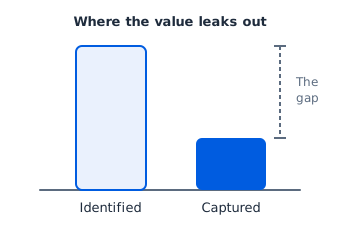
Oscar Pro for Cloudability ingests the savings recommendations Cloudability already produces, correlates them with a live Cloud Intelligence Graph™ of your environment, ranks them by ROI and safety, turns them into owned and tracked tasks, and verifies both completion and realized savings against your billing data. A human approves every action.
How It Works
The improvement engine,
pointed at your Cloudability backlog.
Connect with the Cloudability access you already have. Oscar does the rest from a single operator workstation.
Days To Value
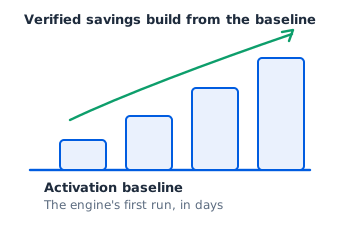
Start with an activation baseline.
The engagement starts with the engine's first run: your existing Cloudability findings ingested, correlated, and returned as a safety-filtered, ROI-ranked plan, typically within days, from one operator workstation using credentials you already have.
From there the subscription keeps the engine on: new findings flow into the same queue, completed work is verified, and your plan stays current instead of aging into next quarter's report.
- No platform deployment, no agents, no InfoSec mountain
- Every position and every exclusion traceable to evidence your engineers can check
- Tag fixes handed back as a byproduct of ownership inference
See your own backlog come back as a plan.
The activation baseline runs on the findings you already have. Days, not quarters.
Proof
The question that shows the difference.
Ask your current tooling, or a bare AI assistant, these questions. Then ask Oscar, with the graph connected.
Complementary
Cloudability gets more valuable.
Oscar Pro does not replace Cloudability, and it does not generate competing recommendations. It adds the context your cloud systems of record don't carry: ownership, dependencies, change history, and blast radius, connected across every system that touches a resource. That context is what turns each recommendation into an understood fix, with the effort and real ROI of capturing it known before anyone starts.
For consultancies and GSIs: Oscar produces the queue; your delivery practice sells the remediation on top of it. We are the system your engagement runs on, not a competitor for the work.
- Findings in from Cloudability; tickets out to Jira or ServiceNow when needed
- Fix effort and ROI understood per finding, not assumed
- The same engine extends to other findings sources as they roll out
- Team sharing: one graph, one queue, visible to everyone who needs it
OpsCanvas is now in Claude Code, Claude Desktop, OpenAI Codex, and ChatGPT Desktop. The same graph, inside the tools your engineers already use.
Practitioners install OpsCanvas MCP free and work from a live map of their cloud inside the AI tool they already run. Oscar Pro adds the hosted graph, shared context, and the team task queue. One graph. Your whole team. Every AI surface.
FAQ
Oscar Pro for Cloudability, answered.
What is Oscar Pro for Cloudability?
Oscar Pro for Cloudability ingests the savings recommendations Cloudability already produces, correlates them with a live Cloud Intelligence Graph™ of your environment, ranks them by ROI and safety, turns them into owned and tracked tasks, and verifies both completion and realized savings against your billing data. A human approves every action.
Does it replace Cloudability?
No. Cloudability remains your cost visibility and recommendation source. Oscar Pro makes those recommendations safe to act on and tracks them to verified outcomes, which makes the Cloudability investment more valuable, not less.
How fast is the first result?
The activation baseline typically completes within days: one operator, one workstation, your existing Cloudability access, and a safety-filtered, ROI-ranked plan at the end. There is no platform deployment and no agent rollout.
Does it need our tagging cleaned up first?
No. Ownership and application membership are inferred from observed evidence: runtime behavior, IaC repositories, and identity signals. Tag corrections come out of the process as a byproduct instead of going in as a prerequisite.
How do you know a fix actually saved money?
Verification runs in two stages. First the configuration change is confirmed against the live environment. Then the spend change is confirmed against billing data over time, so the number your team reports is measured, not assumed. Closing a ticket is never counted as savings.
What about other findings sources?
The engine is source-neutral by design. Cloudability is the first supported source, with Trusted Advisor, Azure Advisor, and resilience platforms like Rubrik, Veeam, and Commvault rolling out, plus ServiceNow as both a source and a ticket target.
Get Started
Bring us the findings you already have.
Start with the activation baseline and see your own backlog come back as a plan.